


Solana has become one of the most active blockchain platforms in the world, with a rapidly expanding ecosystem spanning decentralized finance (DeFi), tokenized assets, and payments. A key factor behind its scalability and efficiency lies in its proof-of-stake (PoS) architecture, where staking plays a foundational role.
For token holders, Solana staking offers a way to earn rewards while directly contributing to the security and performance of the network. This article delves into how staking on Solana functions and the reasons behind its growing appeal to both retail and institutional investors.
What Is Solana Staking?
In traditional proof-of-work (PoW) blockchains like Bitcoin, security is maintained by miners who expend computing power to validate transactions. Solana, like Ethereum post-Merge, uses proof-of-stake (PoS), where validators are chosen to confirm transactions based on the amount of SOL tokens they hold and have staked.
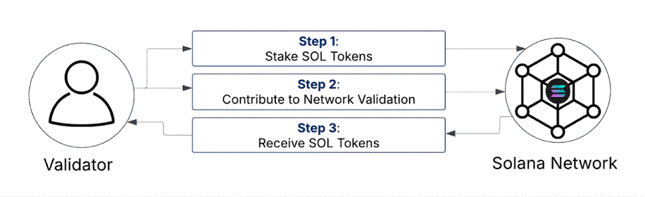
By staking SOL tokens, investors delegate their tokens to Solana validators, who in turn secure the network. This model not only replaces the energy-intensive nature of PoW but also introduces a yield component to token ownership, effectively turning SOL into a yield-bearing asset.
How Solana Staking Works
One of Solana’s strengths is that it uses a delegation model, meaning you don’t need to run your own node or have any technical expertise to start staking. Instead, you simply delegate your stake to a validator of your choice through a wallet or custodian. Each validator sets a commission rate, which is a small percentage of the rewards they take for providing the service. The rest is distributed to those who delegate SOL to them.
This model balances ease of use with strong economic incentives for validator performance. Some unique aspects of Solana’s staking mechanics:
-
No slashing (currently): Unlike some other PoS chains, Solana does not penalize stakers for validator misbehavior, although poor validator performance can still reduce rewards.
-
Staking accounts: Multiple staking accounts can be created from the same wallet, allowing participants to distribute the stake across Solana validators and manage exposure.
-
Validator uptime matters: The more reliable and performant the chosen validator, the better the expected yield.
Staking Rewards and Yield Generation
Staking rewards are primarily funded through inflationary issuance (i.e. new SOL tokens minted by the Solana network), supplemented by a portion of network fees. These rewards are distributed across all stakers proportionally based on their delegated SOL and their validator’s performance.
Factors that influence your staking yield include:
-
Total amount of SOL staked across the Solana network (lower staking = higher APY)
-
The validator's commission rate
-
Validator uptime and success rate
-
The amount of SOL staked and how often rewards are compounded
As of mid-2025, Solana staking yields typically range from 6% to 8% APY, with higher returns possible when compounding is enabled.
Solana’s staking ratio (the percentage of SOL actively staked) is still lower than that of older PoS networks like Cosmos or Ethereum. This means fewer participants are sharing in the rewards, which increases yield for those who do stake.
Over time, as more SOL tokens are staked and inflation tapers, APYs may decrease. However, the system is designed to maintain incentives for participation and decentralization so, for now, early stakers benefit from above-average returns in a network that’s growing fast in both developer activity and economic throughput.
Where Can You Stake Solana?
Solana staking is available across a variety of platforms—from native wallets to exchanges and institutional custodians:
-
Wallets: Popular options like Phantom and Solflare allow users to stake SOL tokens directly from their wallets in just a few clicks.
-
Exchanges: Some major platforms like Coinbase and Binance offer integrated staking services, making it convenient for users who already store their tokens there.
-
Institutional providers: For larger holders, custodians such as Anchorage or Fireblocks offer secure, regulated staking infrastructure.
While some investors will prefer to gain exposure to Solana through self-custody and take delivery of staking rewards via private wallets, others may prefer regulated exchange-traded-products.
Our newly launched 3iQ Solana Staking ETF (SOLQ) combines Solana’s growth potential with a yield enhancement through staking, ultimately aiming to provide a superior vehicle for Solana exposure.
A Solana ETF simplifies the investment process for investors, allowing for easy access through traditional brokerage accounts without the need for direct digital asset custody or understanding the intricacies of blockchain crypto assets. This is because ETF shares are purchased on a regulated exchange, and the ETF issuer and its agents handle and manage the fund’s investment in Solana. Investors in the 3iQ Solana Staking ETF also benefit from staking indirectly, as delegation is integrated into its structure to pass on network rewards received by the fund.
Risks and Considerations
While Solana staking is low-risk, especially due to the absence of slashing, there are risks to consider as with every PoS protocol. For example, validator risk arises when the chosen validator performs poorly or goes offline, and undelegating Solana tokens also requires a cooldown period before tokens become liquid again which could impact an investor's ability to react swiftly to market changes or access their funds when needed.
A Solana Staking ETF alleviates these concerns by providing institutional-grade validator selection and management, thereby lowering the risk of choosing the wrong validator, and offering daily liquidity to investors without directly worrying about on-chain cooldowns. Market volatility, common to all SOL exposure, remains, but the ETF simplifies the overall investment experience.
Conclusion: A User-Friendly Path to Passive Yield
Staking on Solana offers a unique blend of accessibility, yield potential, and network alignment. Whether you're a retail investor using Phantom or an institution holding SOL through a staking-enabled ETF, participating in the staking process helps secure the Solana network while earning rewards.
It’s one of the few ways in digital assets to generate passive income that’s both chain-native and economically aligned. With no need to run a node or worry about slashing risks, staking SOL remains one of the most user-friendly ways to support a blockchain that has become one of the most dominant in terms of utility and performance, all while letting tokens work for their holders.